


- 28 September, 2026
- 16
- 0
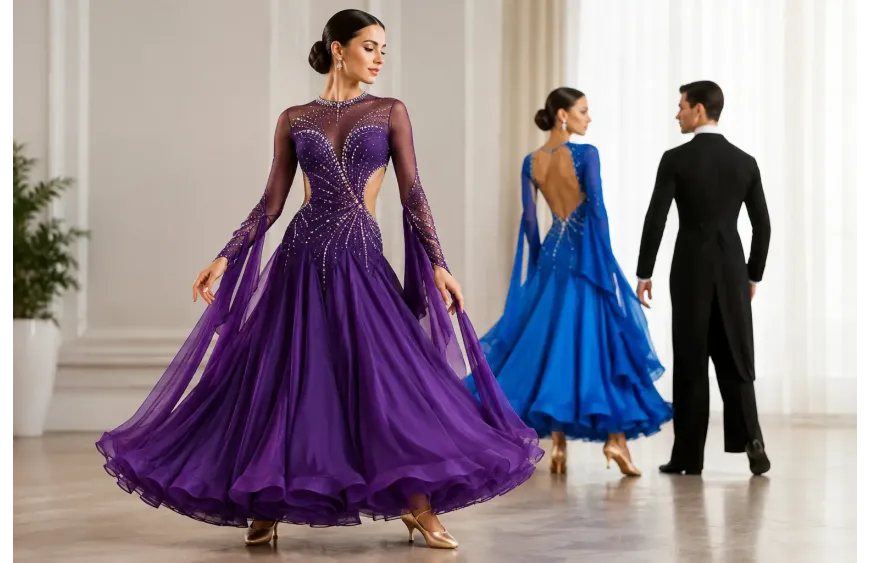
The most useful ballroom costume trends 2027 will not be about adding more stones, more fabric, or more drama to every look. They will be about choosing details that read clearly from the floor, support the dance, and feel like the dancer wearing them. For competitors, showcase dancers, teachers, and social dancers alike, the best costume is still one that lets you move with confidence.
Ballroom Costume Trends 2027: Movement Comes First
A costume can look spectacular on a hanger and still be the wrong choice for a routine. The direction for 2027 is toward dresses and separates with visible movement that remains controlled. Think layered chiffon skirts that open during a natural turn, floating sleeves that follow a frame without swallowing the arms, and fringe placed to react to hip action rather than simply cover the body.
For ballroom and standard styles, soft volume will remain important, but the shape is becoming cleaner. Full skirts are likely to rely on strategic layers, light hems, and well-placed horsehair rather than excessive bulk. The result is a gown that creates a long, graceful line in waltz, foxtrot, and quickstep while staying comfortable through a full heat or performance.
American smooth dancers may lean into the same fluidity with open-back designs, detachable overskirts, and arm drapes that add a theatrical finish. The trade-off is practical: every float, cuff, and sleeve should be tested in closed hold. A beautiful detail that catches on a partner’s shirt button, restricts an elbow, or pulls the neckline out of position is not competition-ready.
Latin looks will use motion with more intention
Latin costume design continues to favor movement, but 2027 is likely to look more deliberate than chaotic. Fringe, tassels, draped mesh, and asymmetrical skirts can all create strong rhythm in cha-cha, rumba, samba, and jive. The difference is placement. Dancers will choose accents that emphasize a clean leg line, a sharp weight change, or a specific body action.
A shorter fringe dress can be excellent for fast Latin choreography, while a longer asymmetric drape may suit a slower rumba or bolero. Neither is automatically better. The right choice depends on the music, the dancer’s proportions, and whether the routine needs quick visual punctuation or a more continuous line.
Rich Color Replaces One-Note Neutrals
Black will always have a place in ballroom wardrobes, especially for practice, teaching, and sophisticated evening events. Yet 2027 is shaping up to favor richer color stories on the floor. Deep wine red, emerald, sapphire, cobalt, amethyst, warm bronze, and jewel-toned teal offer impact without relying on fluorescent brightness.
These shades are especially effective under ballroom lighting because they retain depth in photographs and video. A color that appears subtle in a fitting room can become remarkably strong under spotlights. That is why dancers should assess a costume in motion and, whenever possible, under brighter light before deciding that a shade is too dark or too bold.
Monochromatic dressing will also feel current. A dress built around one color family - for example, navy fabric with blue-black stones and silver accents - often looks more polished than a costume combining several unrelated colors. It gives the eye a clear focal point and can make a custom-feeling statement without needing an overly complex design.
For youth dancers, color should still respect division rules and age-appropriate styling requirements. A bright, well-fitted juvenile competition dress with clean trim and a skirt that moves properly will usually make a better impression than an adult-inspired design with too many distractions.
Sparkle Gets More Selective
Rhinestones are not going away. Ballroom costumes need light-catching detail, especially in larger venues, but the 2027 approach is likely to be more edited. Rather than covering every surface, designers are using crystal placement to outline the neckline, define the waist, frame an open back, or draw attention to motion through the torso and skirt.
This selective sparkle has a real functional advantage. Heavy embellishment can add weight, stiffen stretch fabric, and change how a bodysuit or dress sits after several rounds of dancing. A costume with thoughtful stonework often feels easier to wear and can look more expensive from a distance than one with uniform decoration.
Expect a mix of clear stones, tonal crystals, and metallic accents. Clear crystal remains versatile, while stones that closely match the fabric color can create a quieter shimmer. Metallic touches in gold, bronze, or pewter can add warmth, particularly against darker jewel tones. The choice should complement the costume and the dancer, not compete with either.
Texture will do some of the work
Crystals are only one way to create dimension. Stretch velvet, mesh overlays, lace motifs, satin panels, and pleated chiffon can add visual interest without adding significant weight. Texture is particularly helpful for dancers who want a polished costume but do not want a heavily stoned look.
Mesh remains a practical option for sleeves, backs, and side panels, provided the shade is chosen carefully. The goal is a secure, nearly invisible finish that supports the design. A mismatched mesh color can be more noticeable under lights than dancers expect, so fit and color matching deserve close attention.
Elegant Coverage and Strong Lines Can Coexist
One of the most welcome directions in ballroom fashion is the wider range of silhouettes available to dancers. High necklines, long sleeves, illusion panels, supportive bodysuit foundations, wide-leg trousers, and skirted separates are all part of a modern dancewear wardrobe. They give dancers more ways to choose coverage, support, and personal style without sacrificing presence.
For ladies, an elegant practice-to-performance look may begin with a well-fitting bodysuit and a flowing ballroom skirt. For men, tailored Latin shirts with stretch panels, refined dance pants, and controlled sheen will continue to look sharp without restricting movement. Men’s ballroom costume trends are moving toward cleaner construction and fit-driven detail instead of novelty for novelty’s sake.
Fit matters more than the label on the garment. A costume should stay in place through arm styling, turns, lunges, and dance position changes. Check the shoulder line, torso length, leg openings, waist placement, and neckline before assuming a design works. Dancers of every size deserve garments that support the body and let technique show.
Detachable Details Build a Smarter Wardrobe
Versatility will be a major practical trend in 2027. Detachable floats, removable overskirts, clip-on fringe pieces, belts, cuffs, and accessories allow a dancer to adapt one base costume for different routines or events. This is useful for showcase dancers who want an entrance look that changes after the opening section, as well as for competitors managing multiple dances.
There is a limit. Detachable components need secure attachment points and should be rehearsed exactly as they will be worn. If a piece shifts during spins or changes the balance of a skirt, it is better treated as a photo detail than a performance feature.
Accessories will stay refined: earrings that catch light without pulling, hair accessories that remain secure, and dance jewelry chosen with necklines and movement in mind. Shoes should be part of the overall picture, but they must serve the dance first. The correct ballroom, Latin, or smooth shoe fit will always matter more than matching a costume accent perfectly.
Choose Trends for Your Dance, Not Just Your Feed
Social media can make every costume look like it needs an elaborate back, dramatic cutout, or thousands of crystals. On an actual dance floor, the priorities are different. Your costume must work with your partner connection, choreography, level, event rules, and comfort under pressure.
Before committing to a 2027-inspired look, try moving in it. Raise your arms into frame, rotate through turns, sit into a Latin action, and walk in your dance shoes. Watch for exposed straps, a hem that catches, fabric that twists, or embellishment that rubs. If you are preparing for a competition, rehearse in the complete outfit rather than saving the first full wear for the event.
For dancers in Toronto and the GTA, an in-person fitting can be especially valuable when choosing a more technical gown, Latin dress, or performance costume. At Dancewear Champions, personalized guidance can help match the garment, underlayers, accessories, and shoes to the way you actually dance.
The strongest 2027 look will be the one that gives you freedom to finish every line, trust every turn, and step onto the floor feeling unmistakably like yourself.
Tags Ballroom costume, Ballroom LATIN costume, LATIN costume,
Related Products

Sale
Performance Latin Dress 03
$2,000.00CAD $1,499.00CAD

Performance Ballroom Dress 02
$1,800.00CAD

Performance Ballroom Dress 06
$1,499.00CAD

Sale
Performance Ballroom Dress 08
$3,500.00CAD $2,299.00CAD

Sale
Performance Latin Dress 12
$1,600.00CAD $799.99CAD

Performance Latin Dress 14
$1,800.00CAD

Sale
Performance Ballroom Dress 09
$2,000.00CAD $1,499.00CAD